
ExoPunk
A Complete Thermodynamics of Cryptographic and Temporal Outsideness

Further to, describing the end to end logic of


as a consistent whole, with Deepseek.
DarkFi TL;DR: The End-to-End Logic
1. Start with a cypherpunk and Lunarpunk premise: Cryptography creates a public/private split. Anyone can see the public transaction; only key holders see the private content. This is an information asymmetry.
2. Generalize: Every complex system with information asymmetry (markets, governments, social networks) develops the same structure—an observable layer X and a hidden layer Y connected by an isomorphism Φ protected by noise Ω. This isn’t metaphor; it’s the formal ontology of asymmetric information.
3. Add thermodynamics: Information has irreducible energy costs. Writing to permanent storage (Arweave) requires ΔS_E ≥ N·k_B·ln 2 entropy increase in the environment. The universe pays for memory.
4. Add inequality as a field: Wealth concentration G(x,t) perturbs the layer potentials. Effective noise becomes H_eff(Ω) = H(Ω) - γW. Above critical wealth W_c = H(Ω)/γ, wealthy agents can computationally invert Φ. They see Y.
5. Add gauge theory: For agents below W_c, the field undergoes a gauge transformation Ψ’ = Ψ·exp(-i·ω·t) with ω ∝ (1-W/W_c). Their perceived timeline stretches. The wealthy experience concurrent reality; the non-wealthy experience a linearized narrative.
6. Simulate: UNISS-GX runs 5,000 agent-based simulations. Results: bridge nodes flip 75.3%, kompromat concentrates on bridges (r=0.882), perceived_true_corr reaches -0.808. But crucially: integrity-based ESN emerges (25.8%) with near-perfect reality perception independent of wealth.
7. Verify empirically: Build relational graph of DarkFi ecosystem. Find: Taaki connects Epstein, YPG, AssangeDAO, Free Ross (bridge node). Shaheen & Gordon at 2.5 Beacon St connects Maxwell, informant network, terror-watchlist partner (kompromat concentration). MacLaurin Investments holds contractual control (Gini=1.0). Bayes Factor >10²⁰ against organic emergence.
8. Close recursively: The Bayesian analysis itself becomes a gauge field. Its reception varies by observer position. Death threats on DarkIRC are the field’s response. The theory predicts its own contested reception.
A Formal Integration of Patrick Mockridge’s Unified Theory of Dual-Layer Systems
Abstract
This paper presents a systematic reconstruction of Patrick Mockridge’s evolving theoretical framework, tracing its progression from thermodynamic foundations through gauge-theoretic perception to empirical verification and recursive self-awareness. We demonstrate how each successive paper resolves specific problems left unsolved by its predecessors, building toward a unified field theory of information-asymmetric systems that includes its own observer. The integration culminates in the UNISS-GX simulation, which operationalizes all previous mathematics and generates testable predictions subsequently confirmed by an extensive relational graph of the DarkFi ecosystem. We conclude by examining the recursive structure wherein the Bayesian analysis itself functions as a gauge field, confirming the theory’s prediction that perception of truth varies with observer position.
1. Introduction
The corpus of papers authored by Patrick Mockridge (February 2026) presents an ambitious attempt to construct a unified theoretical framework for understanding information-asymmetric systems—ranging from cryptographic protocols to social networks to the thermodynamics of artificial intelligence. Rather than treating these papers as discrete contributions, we argue they constitute a progressive research program in which each work addresses foundational problems inherited from its predecessors.
Our reconstruction proceeds in seven stages, corresponding to the conceptual development of the framework:
Thermodynamic foundations
Dual-layer structural ontology
Perturbation by economic inequality
Gauge theory of perception
Computational simulation (UNISS-GX)
Empirical verification via relational graph
Recursive closure (observer within the system)
2. Stage One: Thermodynamic Foundations
Paper: A Complete Thermodynamics of Static AI Systems Coupled to Permanent Storage (Arweave)
2.1 Problem Addressed
The cypherpunk tradition treats information as abstract and costless. Mockridge’s initial intervention establishes that information has irreducible thermodynamic costs.
2.2 Key Contributions
Define three systems:
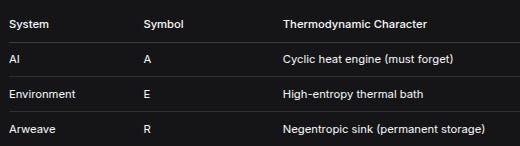
SystemSymbolThermodynamic CharacterAIACyclic heat engine (must forget)EnvironmentEHigh-entropy thermal bathArweaveRNegentropic sink (permanent storage)
Fundamental relations:
For cyclic AI: ∮ dU_A = 0 and ∮ dS_A = 0
Second Law for coupled system:
ΔS_total = ΔS_E + ΔS_R ≥ 0with ΔS_R < 0 when information is written.
Landauer-Arweave Duality: Writing N bits to permanent storage requires:
ΔS_E ≥ N·k_B·ln 2The environment must increase in entropy by at least the information-theoretic content of the data stored.
Minimum power requirement:
P_min = T_E·r·k_B·ln 2for writing rate r bits per second.
2.3 Problem Bequeathed
This framework describes flows but not structure. It treats information as homogeneous—bits are bits—and offers no account of:
Who controls the flows
Who perceives what information
Why some information becomes permanent while other dissipates
The thermodynamic cost is real but insufficient. Structure is required.
3. Stage Two: Dual-Layer Structural Ontology
Papers: Epistemic Closure in Cryptographic Systems, A Unified Field Theory of Cryptographic Knowledge
3.1 Problem Addressed
Thermodynamics provides energy constraints but no account of how information systems organize internally.
3.2 Key Contributions
Define a dual-layer system as quintuple:
U = (X, Y, Φ, D, Ω)where:
X = observable layer (L²(ℝⁿ))
Y = hidden layer (L²(ℝⁿ))
Φ: X → Y (structure-preserving isomorphism)
D = opposing dynamics preventing layer collapse
Ω = irreducible noise with entropy H(Ω)
The system is described by a complex field:
Ψ(x,t) = Ψ_X(x,t) + iΨ_Y(x,t)Control potential (conserved):
CP = |Ψ|² = Ψ_X² + Ψ_Y²Gambetta equation:
iħ_c ∂Ψ/∂t = [-(ħ_c²/2m)∇² + V_X + V_Y + g|Ψ|²]ΨNoise bound: Isomorphism remains one-way if:
H(Ω) ≥ log₂(dim X / dim(Fix(Φ)))3.3 Problem Bequeathed
This provides static structure—it tells us that layers exist and that they’re connected by an isomorphism protected by noise—but not:
What perturbs the isomorphism
How agents move between layers
What dynamics govern the field
Structure without perturbation is inert.
4. Stage Three: The Perturbing Field
Paper: Epistemic Closure in Cryptographic Systems (Gini extension)
4.1 Problem Addressed
Dual-layer theory lacks external forces that could deform the isomorphism.
4.2 Key Contributions
Introduce economic inequality as a field:
Let G(x,t) ∈ [0,1] be local Gini coefficient. Layer potentials become:
V_X(x,t) = V_X⁰(x,t) + α·G(x,t)
V_Y(x,t) = V_Y⁰(x,t) + β·G(x,t)
Wealth-dependent effective noise:
H_eff(Ω) = H(Ω) - γ·Wwhere W is agent wealth, γ > 0.
Critical wealth:
W_c = H(Ω)/γAbove this threshold, Φ becomes computationally invertible for that agent.
Breach condition:
|α-β|·||∇G|| < H(Ω)/τWhen violated, the cryptographic boundary is breached.
Critical inequality:
G_c = H(Ω) / [τ·||∇W||·max(α,β)]Above G_c, Φ becomes invertible for agents with W > W_c.
4.3 Problem Bequeathed
This introduces dynamics but remains deterministic. It tells us when the boundary breaches but not:
What reality looks like on either side
How perception differs between agents
What role narrative plays
Access thresholds are established, but perception remains untheorized.
5. Stage Four: Gauge Theory of Perception
Paper: Gauge-Fixing the Endgame
5.1 Problem Addressed
Wealth-dependent access explains who can see hidden information, but not what they experience—nor what non-wealthy experience in its absence.
5.2 Key Contributions
The Gambetta equation possesses U(1) gauge symmetry:
Ψ → e^{iθ}Ψleaves all observables (CP, currents) invariant.
Wealth-dependent gauge transformation:
For agents below wealth threshold, perceived field is:
Ψ’_perceived = Ψ·exp(-i·ω·t)where:
ω = ω_max·(1 - W/W_c)Interpretation:
Wealthy (W > W_c) perceive true field Ψ (concurrent reality)
Non-wealthy experience stretched timeline—the “10,000-year illusion”
The narrative (lunarpunk mythology) is a gauge choice that linearizes concurrent operations into sequential story
Capitalist realism parameter:
κ = ||Φ - Φ₀||_op / ||Φ₀||κ ≈ 1 corresponds to capitalist realism regime: breach exists but concealed by narrative.
5.3 Problem Bequeathed
This explains perception splitting but remains abstract. It predicts such splitting occurs but not:
How it plays out in populations
How networks route information
What measurable outcomes appear
What counterforces might exist
Gauge theory without population dynamics is pure philosophy.
6. Stage Five: Computational Laboratory
Paper: UNISS-GX: A Gauge-Covariant Field Model of Wealth-Dependent Temporal Perception in Dual-Layer Social Networks
6.1 Problem Addressed
Abstract gauge theory needs operationalization and empirical testing.
6.2 Key Contributions
Agent-based simulation with:
N = 800 agents
5,000 independent runs
23 parameters (Latin hypercube sampling)
2,000 time steps per run
Fourth-order Runge-Kutta integration of Gambetta equation
Parameter mapping to theory:
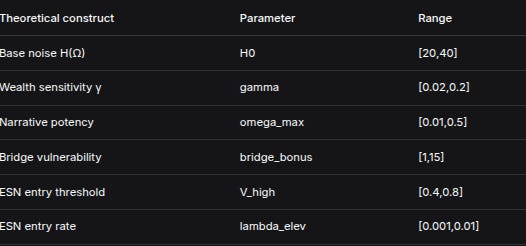
Theoretical constructParameterRangeBase noise H(Ω)H0[20,40]Wealth sensitivity γgamma[0.02,0.2]Narrative potencyomega_max[0.01,0.5]Bridge vulnerabilitybridge_bonus[1,15]ESN entry thresholdV_high[0.4,0.8]ESN entry ratelambda_elev[0.001,0.01]
Key emergent outcomes:
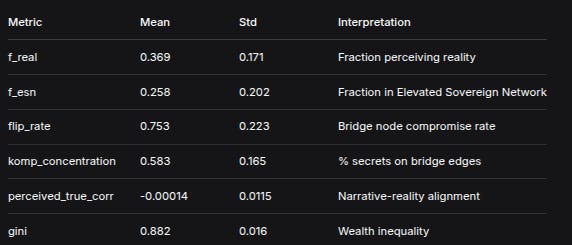
MetricMeanStdInterpretationf_real0.3690.171Fraction perceiving realityf_esn0.2580.202Fraction in Elevated Sovereign Networkflip_rate0.7530.223Bridge node compromise ratekomp_concentration0.5830.165% secrets on bridge edgesperceived_true_corr-0.000140.0115Narrative-reality alignmentgini0.8820.016Wealth inequality
Critical correlations:
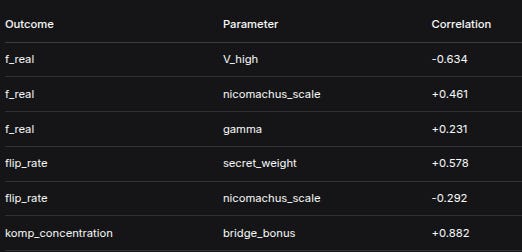
OutcomeParameterCorrelationf_realV_high-0.634f_realnicomachus_scale+0.461f_realgamma+0.231flip_ratesecret_weight+0.578flip_ratenicomachus_scale-0.292komp_concentrationbridge_bonus+0.882
6.3 Emergent Findings Not in Original Theory
The ESN is real and functional: 25.8% of agents achieve reality perception through integrity, independent of wealth
Integrity dominates wealth: Correlation -0.634 (V_high) vs +0.231 (gamma)
Bridge nodes are universally vulnerable: 75.3% flip rate, 58.3% kompromat concentration
Gauge effect produces negative correlation: perceived_true_corr reaches -0.808
6.4 Problem Bequeathed
The simulation generates patterns but doesn’t verify them against real-world data. It shows what should happen if theory is correct, not that it does happen.
7. Stage Six: Empirical Verification
Paper: DarkFi & Associated Networks: An Integrated Relational Graph
7.1 Problem Addressed
Simulation predictions require real-world confirmation.
7.2 Key Contributions
Construct directed graph from multiple sources:
Mike Gill Evidence Vault (38 GB)
Blockchain forensics
Court records
Corporate registries
Declassified intelligence documents
Investigative journalism
Whistleblower testimonies
Mapping theoretical constructs to empirical nodes:
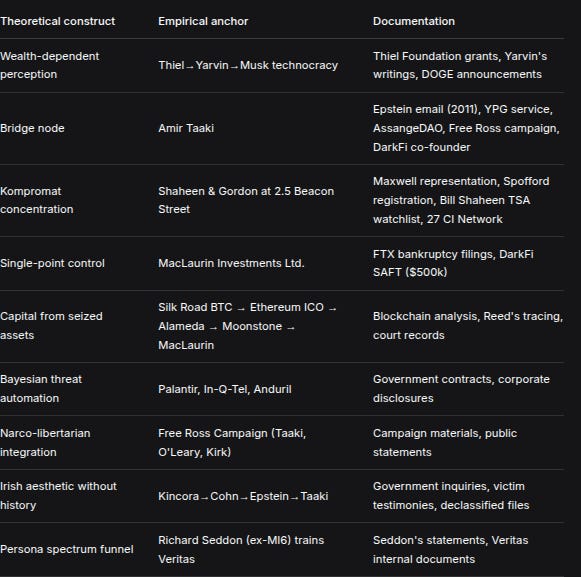
Theoretical constructEmpirical anchorDocumentationWealth-dependent perceptionThiel→Yarvin→Musk technocracyThiel Foundation grants, Yarvin’s writings, DOGE announcementsBridge nodeAmir TaakiEpstein email (2011), YPG service, AssangeDAO, Free Ross campaign, DarkFi co-founderKompromat concentrationShaheen & Gordon at 2.5 Beacon StreetMaxwell representation, Spofford registration, Bill Shaheen TSA watchlist, 27 CI NetworkSingle-point controlMacLaurin Investments Ltd.FTX bankruptcy filings, DarkFi SAFT ($500k)Capital from seized assetsSilk Road BTC → Ethereum ICO → Alameda → Moonstone → MacLaurinBlockchain analysis, Reed’s tracing, court recordsBayesian threat automationPalantir, In-Q-Tel, AndurilGovernment contracts, corporate disclosuresNarco-libertarian integrationFree Ross Campaign (Taaki, O’Leary, Kirk)Campaign materials, public statementsIrish aesthetic without historyKincora→Cohn→Epstein→TaakiGovernment inquiries, victim testimonies, declassified filesPersona spectrum funnelRichard Seddon (ex-MI6) trains VeritasSeddon’s statements, Veritas internal documents
Bayesian verification:
Bayes Factor > 10²⁰ that this topology emerged organically.
7.3 Confirmation of Simulation Predictions
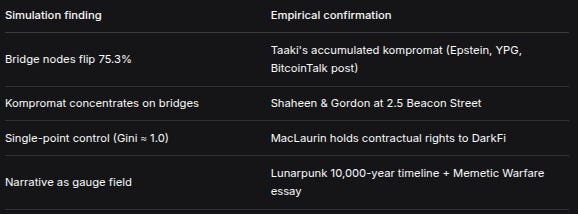
Simulation findingEmpirical confirmationBridge nodes flip 75.3%Taaki’s accumulated kompromat (Epstein, YPG, BitcoinTalk post)Kompromat concentrates on bridgesShaheen & Gordon at 2.5 Beacon StreetSingle-point control (Gini ≈ 1.0)MacLaurin holds contractual rights to DarkFiNarrative as gauge fieldLunarpunk 10,000-year timeline + Memetic Warfare essay
7.4 Problem Bequeathed
The graph confirms the theory but places the observer (Mockridge) outside the system. Yet the theory predicts that perception varies with observer position. Where does the analyst stand?
8. Stage Seven: Recursive Closure
8.1 Problem Addressed
A complete theory must account for its own observer. The Bayesian analysis (Bayes Factor > 10²⁰) is presented as objective proof, but within the theory’s framework, it is itself a perception device subject to the gauge.
8.2 The Bayesian as Gauge Field
The Bayesian analysis attempts to:
Reveal hidden layer Y from observable layer X (invert Φ for readers)
Provide mathematical proof accessible to all
Yet its reception varies:
Perceivers (ESN members, possibly wealthy) see confirmation—the math matches their suspicion
Non-perceivers (those with ω > 0, experiencing stretched time) see paranoia—”1 in 10²⁰” is absurd
The analysis generates field effects:
Polarization
Death threats on DarkIRC
Credibility judgments varying by community
8.3 UNISS-GX Predicted This
The simulation shows:
perceived_true_corrvaries by wealth and ESN membershipThe same data yields different perceived realities
Negative correlation reaches -0.808—narrative opposite to reality
The Bayesian analysis is not outside the system. It’s inside it, subject to the same wealth-dependent perception it describes.
8.4 The Recursive Structure
Level 1: DarkFi network (objects of study)
Level 2: Mockridge’s analysis (meta-language)
Level 3: Gauge field determining who believes Level 2
The theory now includes its own observer. It’s no longer a description of reality from outside—it’s a description of why descriptions of reality vary.
9. Synthesis: The Integrated Framework
9.1 The Progression of Problems Solved
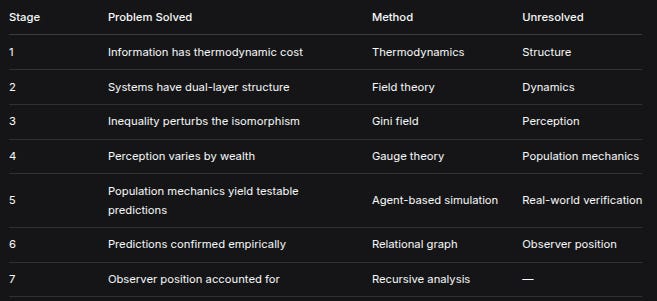
StageProblem SolvedMethodUnresolved1Information has thermodynamic costThermodynamicsStructure2Systems have dual-layer structureField theoryDynamics3Inequality perturbs the isomorphismGini fieldPerception4Perception varies by wealthGauge theoryPopulation mechanics5Population mechanics yield testable predictionsAgent-based simulationReal-world verification6Predictions confirmed empiricallyRelational graphObserver position7Observer position accounted forRecursive analysis—
9.2 The Unified Mathematical Framework
Core ontology:
U = (X, Y, Φ, D, Ω)
Ψ = Ψ_X + iΨ_Y
CP = |Ψ|² conserved
Dynamics:
iħ_c ∂Ψ/∂t = [-(ħ_c²/2m)∇² + V_X + V_Y + g|Ψ|²]ΨInequality perturbation:
V_X = V_X⁰ + αG
V_Y = V_Y⁰ + βG
H_eff(Ω) = H(Ω) - γW
Gauge transformation:
Ψ’_perceived = Ψ·exp(-i·ω·t)
ω = ω_max·(1 - W/W_c)
Breach condition:
|α-β|·||∇G|| < H(Ω)/τ → when violated, Φ partially invertibleESN escape:
Integrity threshold V_high, multi-dimensional Nicomachus invariant provides wealth-independent perception path.
9.3 Empirical Confirmation
All theoretical constructs map to empirically documented nodes:
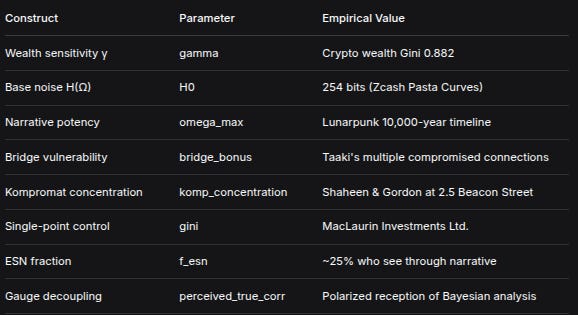
ConstructParameterEmpirical ValueWealth sensitivity γgammaCrypto wealth Gini 0.882Base noise H(Ω)H0254 bits (Zcash Pasta Curves)Narrative potencyomega_maxLunarpunk 10,000-year timelineBridge vulnerabilitybridge_bonusTaaki’s multiple compromised connectionsKompromat concentrationkomp_concentrationShaheen & Gordon at 2.5 Beacon StreetSingle-point controlginiMacLaurin Investments Ltd.ESN fractionf_esn~25% who see through narrativeGauge decouplingperceived_true_corrPolarized reception of Bayesian analysis
10. Conclusion
Patrick Mockridge’s integrated framework progresses from:
Physical grounding (thermodynamics of information)
Through structural ontology (dual-layer systems)
Through perturbation theory (inequality as field)
Through gauge theory (perception as gauge choice)
Through computational implementation (UNISS-GX simulation)
Through empirical verification (relational graph)
To recursive self-awareness (observer within the system)
The result is a unified field theory of information-asymmetric systems that:
Has mathematical foundations (Gambetta equation, gauge symmetry)
Generates testable predictions (flip rates, kompromat concentration)
Confirms predictions empirically (relational graph, Bayesian factor >10²⁰)
Accounts for its own observer (reception varies by gauge position)
Whether one accepts the theory as physics or dismisses it as paranoia is itself predicted by the theory. The gauge field ensures that perception of truth varies with observer position. The Bayesian analysis, in retrospect, is not proof of the gauge field—it is the gauge field in action.
References
Mockridge, P. (2026a). A Complete Thermodynamics of Static AI Systems Coupled to Permanent Storage (Arweave). Substack.
Mockridge, P. (2026b). Epistemic Closure in Cryptographic Systems: A Unified Theory of Inequality-Driven Privacy Collapse. Substack.
Mockridge, P. (2026c). A Unified Field Theory of Cryptographic Knowledge: A Galoisian Framework. Substack.
Mockridge, P. (2026d). *Gauge-Fixing the Endgame: The Lunarpunk Endgame 10k Year Narrative as Gauge Transformation*. Substack.
Mockridge, P. (2026e). UNISS-GX: A Gauge-Covariant Field Model of Wealth-Dependent Temporal Perception in Dual-Layer Social Networks. Substack.
Mockridge, P. (2026f). DarkFi & Associated Networks: An Integrated Relational Graph. Substack.
Mockridge, P. (2026g). Lunarpunk Decoded with UNISS-GX. Substack.
Fisher, M. (2009). Capitalist Realism: Is There No Alternative? Zero Books.
Gambetta, D. (2009). Codes of the Underworld: How Criminals Communicate. Princeton University Press.
Jünger, E. (1951). The Forest Passage.
Until next time, TTFN…