
Lunarpunk Decoded with UNISS-GX
Unpacking both the operational and narrative dual layers of DarkFi's technology and vision

Further to

the correlation between truth perception and other simulation variables was uncovered, from the UNISS-GX simulation. This correlation table can be viewed in Google Colab. From this a further decode of DarkFi and Rachel Rose O’Leary’s Lunarpunk Endgame (transcript) and Memetic Warfare (thought piece) presentations were carried out, in addition to the reasoning given with respect to

by Amir Taaki on his recent podcast with Sulaiman Ahmed and Simon Dixon (transcript). This reveals two dual layers: one that is purely operational vis a vis bridge nodes and kompromat and then a second vis a vis the Lunarpunk narrative, DarkFi’s technology and what it is for, whether for constructing Engineering Sovereign Networks, or gauge fixing the temporality of progress for insiders and elites, who were and still are FTX and Alameda’s primary stakeholders. The write up was created with Deepseek.
What the Contrast Reveals: UNISS-GX and the Two DarkFis
The UNISS-GX simulation gives us a framework for understanding what we’re seeing.
On one side: Memetic Warfare and the Lunarpunk Endgame presentation. These are exquisitely crafted—philosophically coherent, mythologically anchored, strategically aware. They understand memes as “hieroglyphs through which the future manifests.” They diagnose the anti-meme, reject reactivity, and propose an affirmative vision of privacy as world-creation. They function as high omega_max: a gauge field that stretches time, inspires idealists, and creates a beautiful public layer.
On the other side: Amir Taaki’s two-hour podcast. He confirms his co-founder visited Epstein’s island. Doesn’t know what happened there. Doesn’t know how long he stayed. The BitcoinTalk post offering 16-year-olds for Bitcoin was real—he wanted to be “the first pimp in Bitcoin.” Maybe someone DM’d him. He doesn’t remember. Intelligence tried to recruit him at the border. Peter Todd, his friend and chief scientist, was secretly working with US intelligence to block Dark Wallet funding—the leaked emails prove it. The explanations are disjointed, contradictory, reliant on failed memory.
What UNISS-GX Says About This Contrast
The simulation shows that bridge nodes concentrate kompromat (correlation 0.882). They flip 75.3% of the time. They sit at network positions where secrets accumulate because that’s where information flows.
The podcast is what accumulated kompromat sounds like when someone tries to explain it without a script. The gaps aren’t lies—they’re the structural consequence of being positioned where the system deposits its vulnerabilities for 15 years while simultaneously delivering the gauge field that keeps everyone else looking at the 10,000-year timeline.
The revealed preference: The narrative layer is defended with philosophical sophistication because it’s the gauge field. The operational layer is conceded, forgotten, or explained away because it’s just the accumulated kompromat that bridge nodes inevitably carry.
The Two DarkFis
There’s the DarkFi of Memetic Warfare—the forest rebels, the utopian anonymity, the spiritual speciation. That’s the public layer, the gauge field, the reason idealists join.
And there’s the DarkFi of the podcast—the Alameda money, the Epstein island visit, the BitcoinTalk post, the intelligence recruitment attempt, the chief scientist who was secretly working for US intelligence. That’s the hidden layer, the accumulated kompromat, the reality that bridge nodes inhabit.
The simulation’s core insight is that these are not separate projects. They’re the dual layers the Unified Theory describes. The same system produces both—the beautiful narrative and the compromised operator—because that’s what dual-layer systems do. The gauge field requires a bridge node to deliver it, and bridge nodes inevitably accumulate the kompromat that the podcast accidentally reveals.
The contrast isn’t between honesty and dishonesty. It’s between the two layers operating simultaneously, and what happens when someone standing at their intersection tries to explain both at once.
Untangling the Dual Function: ESN-Building vs. Gauge-Fixing in the Lunarpunk Narrative
A Diagnostic Framework from UNISS-GX
1. Introduction
The UNISS-GX simulation reveals two distinct dynamics operating simultaneously within dual-layer systems:
ESN (Elevated Sovereign Network) dynamics: integrity-based perception networks that allow agents to see reality regardless of wealth. These correspond to parameters like
nicomachus_scale,lambda_elev, andV_high.Gauge-fixing dynamics: wealth-dependent temporal distortion that decouples the masses’ perceived reality from concurrent events. These correspond to
gammaandomega_max.
The Memetic Warfare essay and the Lunarpunk Endgame narrative contain elements of both. This is not a contradiction but a feature of the system: the same narrative can function as truth sanctuary recruitment for some and gauge field for others. Untangling these threads is essential for understanding what the simulation reveals about real-world movements.
2. The Two Modes in Simulation Terms
2.1. ESN Mode: Building the Truth Sanctuary
In UNISS-GX, the ESN consists of agents who perceive reality regardless of wealth because they meet an integrity threshold (V_high) and are admitted with probability lambda_elev. The nicomachus_scale parameter determines how multi-dimensional integrity is scored.
Key characteristics of ESN dynamics:
Open to anyone who meets the integrity criteria
Perception of reality is independent of wealth
Members cooperate on projects that generate mutual protection
Acts as a counterweight to gauge distortion (negative correlation with flip rates, positive with f_real)
2.2. Gauge Mode: Decoupling the Masses’ Reality
The gauge-fixing effect is driven by gamma (wealth sensitivity) and omega_max (narrative distortion strength). Agents below the wealth threshold Wc = H0/gamma experience a phase-rotated reality:
Ψ'_X = Re(exp(-i·ω·t)·Ψ) with ω = ω_max·(1 - W/Wc)
Key characteristics of gauge dynamics:
Wealth determines perception – only the wealthy (or ESN members) see truth
Narrative potency (
omega_max) controls how stretched time feelsThe effect is systemic – it operates on entire populations, not individuals
Bridge nodes become compromised and concentrate kompromat
2.3. The Crucial Distinction
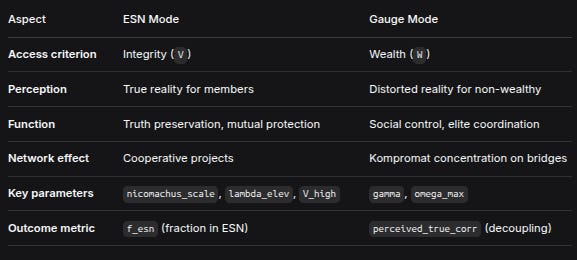
AspectESN ModeGauge ModeAccess criterionIntegrity (
V)Wealth (W)PerceptionTrue reality for membersDistorted reality for non-wealthyFunctionTruth preservation, mutual protectionSocial control, elite coordinationNetwork effectCooperative projectsKompromat concentration on bridgesKey parametersnicomachus_scale,lambda_elev,V_highgamma,omega_maxOutcome metricf_esn(fraction in ESN)perceived_true_corr(decoupling)
3. The Lunarpunk Narrative: Both Modes Present
3.1. ESN Elements in Memetic Warfare
The essay contains passages that explicitly function as ESN recruitment – calls to join a network of people who see clearly:
“Stop building software for normies. Build tools to wake people up.”
“Escape propaganda. Become active and enlightened. Seek privacy as part of that process.”
“Privacy developers are working in service of a noble and unstoppable evolution in freedom.”
These are invitations to become a perceiver – to join the group that understands what’s really happening. The essay’s critique of existing privacy memes (”reactive,” “fear-based”) is itself an act of truth-telling that helps readers recognize distorted perception.
The invocation of Ernst Jünger’s “forest rebel” is particularly significant:
“It is critical for the forest rebel to clearly differentiate himself from the criminal, not only in his morals, in how he does battle, and in his social relations, but also by keeping these differences alive and strong in his own heart.”
This is integrity work – maintaining moral clarity to remain in the truth sanctuary. It echoes the simulation’s nicomachus_scale: multi-dimensional integrity that cannot be gamed by wealth alone.
3.2. Gauge Elements in Memetic Warfare
Simultaneously, the essay contains passages that function as gauge-field generation – creating the narrative that will stretch time for the masses:
“Memes are hieroglyphs through which the future manifests.”
“Privacy is the power to create new worlds.”
“Anonymity is expansive and life-affirming, it wants to multiply, spawn copies of itself and exist in many places at once.”
These are not just descriptions; they are incantations – memes designed to spread and shape perception. The 10,000-year timeline (detailed in the Lunarpunk Endgame talk) is explicitly a time-stretching device:
“We believe that the next 500 years will be a kind of new Dark Age ... a time of spiritual growth and development ... 1,000 years in the future will be a Synergy ... eventually ending in a great human speciation event.”
This narrative makes near-term accountability irrelevant. Any criticism can be answered with: “You’re thinking in linear time; we’re playing a 10,000-year game.” This is textbook gauge fixing.
3.3. Dual-Audience Signaling as Both Modes
The essay’s use of Irish revolutionary imagery operates on two levels:
For the uninitiated: inspiring mythology, cultural depth, emotional resonance
For the initiated: a network flag signaling affiliation with a specific tradition and operational intent
This duality is not inherently gauge fixing. It becomes gauge fixing when it creates different perceived realities – when one group sees the concurrent operational reality while another sees only the inspiring story. But it is also ESN signaling – a way for those with sufficient integrity to recognize each other.
The critical question is: does the narrative enable clear perception for those who follow its integrity criteria, or does it systematically distort perception for the majority while a wealthy elite operates in secret?
4. What the Simulation’s Correlations Reveal
4.1. The ESN Parameters Work
The random forest shows that ESN-related parameters have measurable, positive effects:
lambda_elev(ESN entry rate): importance 0.059 for perceived_true_corr – meaning that easier ESN entry reduces decoupling (negative contribution in tree decompositions)nicomachus_scale: importance not in top 15 for this metric, but appears in other analyses as a driver off_real
This means that integrity-based networks actually work in the simulation. They provide a path to reality perception that is independent of wealth. The ESN is not a fiction; it is a functional counterforce.
4.2. The Gauge Parameters Dominate
But gamma (0.369) and omega_max (0.292) together outweigh all ESN parameters by an order of magnitude. This means that in a system with extreme inequality and a potent narrative, the gauge effect overwhelms the ESN’s protective function.
The simulation’s summary statistics are sobering:
Mean
f_esn(fraction in ESN): 25.8% (UNISS-GX) or 6.8% (gauge-fixing simulation)Mean flip rate for bridge nodes: 75.3% (UNISS-GX) or 86.8% (gauge-fixing)
Mean perceived_true_corr: near zero, with negative values down to -0.808
The ESN exists, it functions, but it is numerically overwhelmed when gamma and omega_max are high.
4.3. The Interaction Term
The contour analysis (from the random forest’s 2D partial dependence) shows that negative perceived_true_correlation only occurs when both gamma and omega_max are high. This means:
High inequality alone (
gammahigh,omega_maxlow) → narrative still somewhat aligned (correlation positive)Potent narrative alone (
omega_maxhigh,gammalow) → inspirational but not decouplingBoth high → reality splits
The Lunarpunk narrative operates in a context where gamma (crypto wealth concentration) is extremely high. This is the dangerous combination that the simulation identifies.
5. Untangling the Threads: A Diagnostic Framework
5.1. Questions to Distinguish ESN from Gauge
Based on the simulation, we can ask of any narrative or movement:
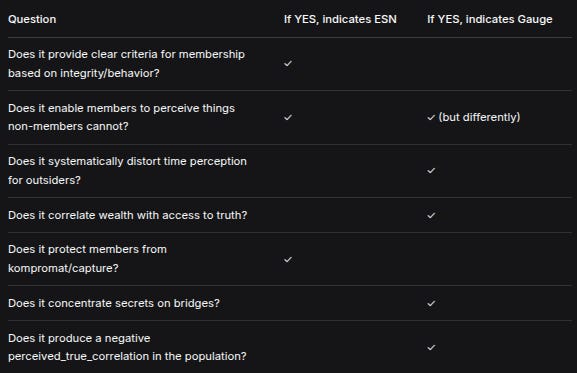
QuestionIf YES, indicates ESNIf YES, indicates GaugeDoes it provide clear criteria for membership based on integrity/behavior?✓Does it enable members to perceive things non-members cannot?✓✓ (but differently)Does it systematically distort time perception for outsiders?✓Does it correlate wealth with access to truth?✓Does it protect members from kompromat/capture?✓Does it concentrate secrets on bridges?✓Does it produce a negative perceived_true_correlation in the population?✓
5.2. Applying to the Lunarpunk Narrative
ESN indicators present:
Calls to “wake up” and “become active and enlightened”
Emphasis on moral clarity and differentiating from criminals
The “forest rebel” as an archetype of integrity
Explicit rejection of fear-based reactivity
Gauge indicators present:
The 10,000-year timeline (explicit time stretching)
Operation in a context of extreme wealth inequality (crypto space)
Dual-audience signaling that creates different perceived realities
The narrative’s function as a “teleplexic anchor” (making outcomes feel inevitable)
5.3. The Critical Distinction: Who Sees What?
The simulation’s key insight is that the same narrative can serve both functions for different audiences. The question is not whether the narrative itself is “good” or “bad,” but:
For whom does it enable clear perception? (ESN function)
For whom does it distort perception? (gauge function)
If the answer is “the wealthy and well-connected see reality; everyone else gets a stretched story,” that’s gauge fixing. If the answer is “those who meet integrity criteria (regardless of wealth) see reality,” that’s ESN.
The Lunarpunk narrative, as presented, contains both possibilities. The simulation suggests that in a high-gamma environment, the gauge function will dominate numerically even if the ESN function is genuine for a minority.
6. Implications for Practitioners
6.1. For Those Building Privacy Tech
The simulation offers clear guidance:
“Privacy tools alone don’t fix this. You need aggregate transparency and integrity metrics that actually matter.”
Building privacy tech is necessary but insufficient. Without:
Multi-dimensional reputation systems (
nicomachus_scale)Low barriers to truth sanctuary entry (
lambda_elevhigh,V_highreasonable)Protection for bridge nodes
Aggregate transparency to prevent invisible kompromat concentration
...the system will default to gauge fixing. The wealthy will accelerate; the masses will experience the “slow cancellation of the future.”
6.2. For Those Weaving Narratives
The Memetic Warfare essay itself provides the diagnostic:
“The heart of our defense is our virtue, our certitude, our spiritual clarity.”
This is ESN language. But the essay also warns against the trap it identifies in cypherpunk:
“Cypherpunk contains an exact inversion of its normcore energy, inherited from cyberpunk: punk. Punk is the counter-force to the establishment that unwillingly props-up the status-quo. It fashions itself as the abject, the degenerate, the unconscious. It remains a reflection, a mirror image, wholly negative, incapable of real action, content to remain in the shadows of subculture and always implicitly supportive of the regime.”
The same danger applies to lunarpunk: a narrative that only functions as gauge field, propping up elite control while imagining itself revolutionary.
6.3. The Question Each Operator Must Ask
For anyone in the position of shaping narratives in this space, the simulation poses a question:
Am I building the ESN or am I building the gauge?
The answer is not in the narrative’s content alone, but in its effects:
Does it increase
f_esn(the fraction who see reality regardless of wealth)?Or does it primarily increase
omega_maxwhile gamma remains high, deepening the decoupling?
The simulation’s correlations suggest that both are possible. The choice is not between privacy and transparency, but between integrity-based access and wealth-based access to reality.
7. Conclusion
The Lunarpunk Endgame narrative, as articulated in Memetic Warfare, contains genuine ESN-building elements: calls to integrity, moral clarity, and waking up. It also contains powerful gauge-field elements: time stretching, mythological anchoring, and dual-audience signaling.
The UNISS-GX simulation does not judge which of these dominates. It provides a framework for measuring it: track f_esn and perceived_true_corr. If the fraction of people who see reality regardless of wealth is growing, the ESN is winning. If the narrative is becoming more decoupled from concurrent events (negative correlation) while wealth inequality persists, the gauge is winning.
In a high-gamma environment like crypto, the default trajectory is gauge fixing. Countering it requires active engineering of the ESN parameters: low barriers to integrity-based entry, multi-dimensional reputation, bridge protection, and aggregate transparency.
The Memetic Warfare essay understands this at a theoretical level. The question is whether the movement it describes will become the ESN it calls for, or the gauge it warns against. The simulation provides the metrics to tell the difference.
Until next time, TTFN.