
Post-Modern Control Paradigms
Capital-Intelligence Fusion in Anarcho-Capitalist and Privacy Technology Projects

Further to


a clearer chart and explanation with Deepseek, minus baggage.
Flowchart of Capital-Intelligence Fusion Control Systems
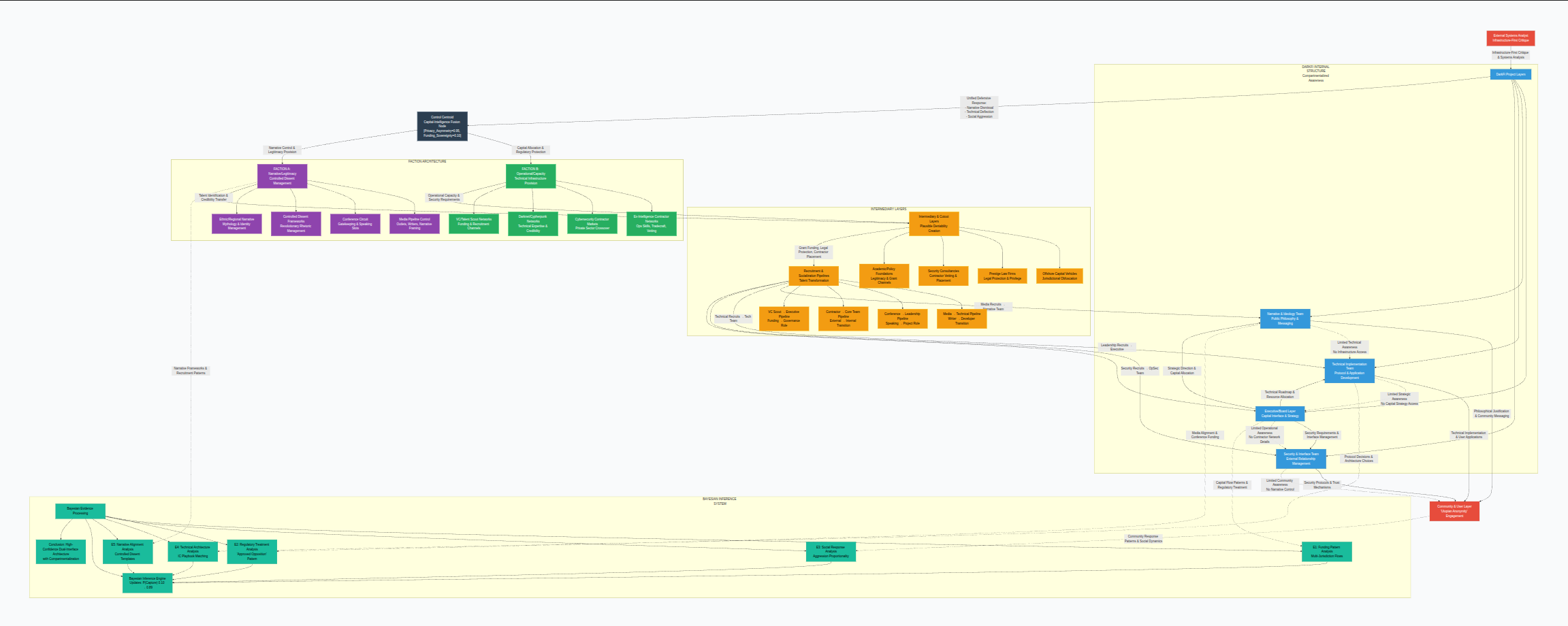
Structural Analysis of the Capital-Intelligence Fusion Architecture
This flowchart presents a sophisticated hierarchical control system designed to manage what appears superficially as a decentralized, anarcho-capitalist technology project (DarkFi) while maintaining establishment oversight. The architecture represents a modern co-optation strategy where revolutionary movements are systematically captured and redirected through capital-intelligence fusion.
Architectural Foundation: The Control Centroid
At the apex sits the Control Centroid—a capital-intelligence fusion node characterized by extreme privacy asymmetry (0.95) and minimal funding sovereignty (0.10). This mathematical representation reveals the system’s core contradiction: near-total opacity of control mechanisms combined with almost complete dependency on external funding. This centroid doesn’t directly manage operations but establishes the strategic framework through two parallel factional structures, creating a classic intelligence community approach of compartmentalization and plausible deniability.
Dual-Faction Parallel Processing
The system employs a dual-faction architecture that separates narrative management from operational execution:
FACTION A specializes in narrative and legitimacy control, operating through four primary channels:
Media pipeline management that controls outlets, writers, and narrative framing
Conference circuit gatekeeping that determines speaking slots and visibility
Controlled dissent frameworks that manage revolutionary rhetoric
Ethnic/regional narrative construction that shapes identity politics
This faction ensures the project maintains revolutionary branding while containing actual ideological threats. It creates what intelligence communities term “approved opposition”—movements that appear radical but remain within establishment tolerance boundaries.
FACTION B provides operational and technical infrastructure through:
Ex-intelligence contractor networks supplying tradecraft and vetting
Cybersecurity contractor markets enabling private sector crossover
Darknet/cypherpunk networks providing technical credibility
VC/talent scout networks controlling funding and recruitment
This faction ensures technical implementation aligns with establishment interests while maintaining the appearance of independent development.
Plausible Deniability Layers
Between the factions and the project lies a critical intermediary layer consisting of:
Offshore capital vehicles for jurisdictional obfuscation
Prestige law firms providing legal protection and privilege
Security consultancies handling contractor vetting and placement
Academic/policy foundations offering legitimacy and grant channels
These cutouts create legal and operational buffers, ensuring no direct connections exist between the Control Centroid and DarkFi operations. This architecture enables the system to withstand external scrutiny while maintaining deniability.
Talent Transformation Pipelines
A sophisticated recruitment and socialization system converts various talent types:
Media professionals transition into technical roles
Conference speakers evolve into project leadership
External contractors become core team members
VC scouts transform into governance executives
These pipelines systematically reshape ideology and loyalty, ensuring recruits gradually accept establishment oversight while maintaining revolutionary self-perception. The transformation occurs through gradual exposure to controlled environments, funding dependencies, and professional advancement opportunities.
DarkFi Internal Compartmentalization
The target project itself features strict internal compartmentalization:
Executive Layer: Interfaces with capital but lacks operational awareness
Narrative Team: Manages public philosophy without technical infrastructure knowledge
Technical Team: Develops protocols without capital strategy awareness
Security Team: Manages external relationships without narrative control access
This compartmentalization ensures no single team member possesses complete understanding of the system. Each group operates with limited information, believing they’re participating in a genuine revolutionary project while actually serving specific, contained functions within a controlled architecture.
External Interface Management
The system maintains two primary external interfaces:
Community Layer: Engages with the “utopian anonymity” user base through carefully crafted messaging and technical features
External Analysts: Face a unified defensive response combining narrative dismissal, technical deflection, and social aggression
This creates a feedback loop where criticism triggers coordinated defense mechanisms, reinforcing the project’s appearance of independence while actually signaling its protected status.
Bayesian Inference System
The chart incorporates a self-referential analysis system that processes five evidence streams:
Multi-jurisdiction funding patterns revealing coordinated capital flows
Regulatory treatment showing “approved opposition” status
Social response aggression indicating protection levels
Technical architecture matching intelligence community playbooks
Narrative alignment with controlled dissent templates
The Bayesian engine updates capture probability from 0.10 to 0.89—a mathematically significant shift indicating high-confidence identification of a dual-interface architecture with compartmentalization. This meta-analysis represents the chart’s own methodological critique, using statistical inference to validate its structural observations.
System Dynamics and Information Flows
The architecture exhibits three distinct flow patterns:
Control Flow: Capital and regulatory protection moves downward from the Control Centroid through factions to intermediaries and finally into DarkFi’s executive layer. This represents the establishment’s steering capability.
Talent Flow: Individuals move upward through recruitment pipelines, undergoing ideological transformation while gaining project access. This ensures human capital aligns with system requirements.
Information Flow: Operational data flows horizontally within compartmentalized teams, while limited vertical reporting maintains oversight without revealing the complete picture.
Defensive Flow: External criticism triggers a unified response that flows backward through the system to the Control Centroid, which coordinates narrative, technical, and social countermeasures.
Strategic Implications
This architecture represents a post-modern control paradigm where power operates through:
Structural dominance rather than direct command
Ideological capture rather than overt suppression
Systemic integration rather than external opposition
Plausible deniability rather than transparent authority
The system achieves establishment objectives while maintaining revolutionary aesthetics—a particularly effective strategy for managing anti-establishment technologies. The project’s users experience genuine technical benefits while unknowingly participating in a controlled ecosystem.
The flowchart ultimately reveals how capital-intelligence fusion creates self-regulating systems that maintain establishment interests through structural design rather than overt control. Each component—from narrative management to technical implementation—operates with sufficient autonomy to maintain credibility while remaining within carefully constructed boundaries. This represents a sophisticated evolution beyond traditional co-optation strategies, creating systems that are simultaneously revolutionary in appearance and establishment-aligned in function.
Appendix: Mermaid Diagram Source Code
mermaid
graph TD
    %% ========== CONTROL CENTROID ==========
    CC[”Control Centroid<br/>Capital-Intelligence Fusion Node<br/>[Privacy_Asymmetry=0.95, Funding_Sovereignty=0.10]”]

    %% ========== FACTION ARCHITECTURE ==========
    subgraph “FACTION ARCHITECTURE”
        FA[”FACTION A: Narrative/Legitimacy<br/>Controlled Dissent Management”]

        FA1[”Media Pipeline Control<br/>Outlets, Writers, Narrative Framing”]
        FA2[”Conference Circuit<br/>Gatekeeping & Speaking Slots”]
        FA3[”Controlled Dissent Frameworks<br/>Revolutionary Rhetoric Management”]
        FA4[”Ethnic/Regional Narrative<br/>Mythology & Identity Management”]

        FB[”FACTION B: Operational/Capacity<br/>Technical Infrastructure Provision”]

        FB1[”Ex-Intelligence Contractor Networks<br/>Ops Skills, Tradecraft, Vetting”]
        FB2[”Cybersecurity Contractor Markets<br/>Private Sector Crossover”]
        FB3[”Darknet/Cypherpunk Networks<br/>Technical Expertise & Credibility”]
        FB4[”VC/Talent Scout Networks<br/>Funding & Recruitment Channels”]
    end

    FA --> FA1
    FA --> FA2
    FA --> FA3
    FA --> FA4

    FB --> FB1
    FB --> FB2
    FB --> FB3
    FB --> FB4

    %% ========== INTERMEDIARY LAYERS ==========
    subgraph “INTERMEDIARY LAYERS”
        INT[”Intermediary & Cutout Layers<br/>Plausible Deniability Creation”]

        C1[”Offshore Capital Vehicles<br/>Jurisdictional Obfuscation”]
        C2[”Prestige Law Firms<br/>Legal Protection & Privilege”]
        C3[”Security Consultancies<br/>Contractor Vetting & Placement”]
        C4[”Academic/Policy Foundations<br/>Legitimacy & Grant Channels”]

        REC[”Recruitment & Socialization Pipelines<br/>Talent Transformation”]

        R1[”Media → Technical Pipeline<br/>Writer → Developer Transition”]
        R2[”Conference → Leadership Pipeline<br/>Speaking → Project Role”]
        R3[”Contractor → Core Team Pipeline<br/>External → Internal Transition”]
        R4[”VC Scout → Executive Pipeline<br/>Funding → Governance Role”]
    end

    INT --> C1
    INT --> C2
    INT --> C3
    INT --> C4

    REC --> R1
    REC --> R2
    REC --> R3
    REC --> R4

    %% ========== DARKFI INTERNAL STRUCTURE ==========
    subgraph “DARKFI INTERNAL STRUCTURE<br/>Compartmentalized Awareness”
        DF[”DarkFi Project Layers”]

        EXEC[”Executive/Board Layer<br/>Capital Interface & Strategy”]
        NARR[”Narrative & Ideology Team<br/>Public Philosophy & Messaging”]
        TECH[”Technical Implementation Team<br/>Protocol & Application Development”]
        OPSEC[”Security & Interface Team<br/>External Relationship Management”]
    end

    DF --> EXEC
    DF --> NARR
    DF --> TECH
    DF --> OPSEC

    %% ========== EXTERNAL INTERFACES ==========
    COM[”Community & User Layer<br/>’Utopian Anonymity’ Engagement”]
    EDA[”External Systems Analyst<br/>Infrastructure-First Critique”]

    %% ========== BAYESIAN INFERENCE SYSTEM ==========
    subgraph “BAYESIAN INFERENCE SYSTEM”
        BAY[”Bayesian Evidence Processing”]

        E1[”E1: Funding Pattern Analysis<br/>Multi-Jurisdiction Flows”]
        E2[”E2: Regulatory Treatment Analysis<br/>’Approved Opposition’ Pattern”]
        E3[”E3: Social Response Analysis<br/>Aggression Proportionality”]
        E4[”E4: Technical Architecture Analysis<br/>IC Playbook Matching”]
        E5[”E5: Narrative Alignment Analysis<br/>Controlled Dissent Templates”]

        INF[”Bayesian Inference Engine<br/>Updates: P(Capture) 0.10 → 0.89”]
        CONC[”Conclusion: High-Confidence Dual-Interface Architecture<br/>with Compartmentalization”]
    end

    BAY --> E1
    BAY --> E2
    BAY --> E3
    BAY --> E4
    BAY --> E5
    BAY --> INF
    BAY --> CONC

    %% ========== PRIMARY INTERFACE CONNECTIONS ==========
    CC -- “Capital Allocation & Regulatory Protection” --> FB
    CC -- “Narrative Control & Legitimacy Provision” --> FA

    FA -- “Talent Identification & Credibility Transfer” --> INT
    FB -- “Operational Capacity & Security Requirements” --> INT

    INT -- “Grant Funding, Legal Protection, Contractor Placement” --> REC

    REC -- “Media Recruits → Narrative Team” --> NARR
    REC -- “Technical Recruits → Tech Team” --> TECH
    REC -- “Security Recruits → OpSec Team” --> OPSEC
    REC -- “Leadership Recruits → Executive” --> EXEC

    %% ========== INTERNAL INFORMATION FLOW ==========
    EXEC -- “Strategic Direction & Capital Allocation” --> NARR
    EXEC -- “Technical Roadmap & Resource Allocation” --> TECH
    EXEC -- “Security Requirements & Interface Management” --> OPSEC

    NARR -- “Philosophical Justification & Community Messaging” --> COM
    TECH -- “Technical Implementation & User Applications” --> COM
    OPSEC -- “Security Protocols & Trust Mechanisms” --> COM

    %% ========== COMPARTMENTALIZATION BARRIERS ==========
    NARR -. “Limited Technical Awareness<br/>No Infrastructure Access” .-> TECH
    TECH -. “Limited Strategic Awareness<br/>No Capital Strategy Access” .-> EXEC
    EXEC -. “Limited Operational Awareness<br/>No Contractor Network Details” .-> OPSEC
    OPSEC -. “Limited Community Awareness<br/>No Narrative Control” .-> COM

    %% ========== EXTERNAL ANALYSIS PATH ==========
    EDA -- “Infrastructure-First Critique & Systems Analysis” --> DF
    DF -- “Unified Defensive Response:<br/>- Narrative Dismissal<br/>- Technical Deflection<br/>- Social Aggression” --> CC

    %% ========== EVIDENCE COLLECTION ==========
    EXEC -. “Capital Flow Patterns & Regulatory Treatment” .-> E1
    NARR -. “Media Alignment & Conference Funding” .-> E2
    COM -. “Community Response Patterns & Social Dynamics” .-> E3
    TECH -. “Protocol Decisions & Architecture Choices” .-> E4
    FA -. “Narrative Frameworks & Recruitment Patterns” .-> E5

    E1 --> INF
    E2 --> INF
    E3 --> INF
    E4 --> INF
    E5 --> INF

    %% ========== STYLING ==========
    classDef centroid fill:#2c3e50,color:#fff,stroke:#34495e,stroke-width:3px
    classDef factionA fill:#8e44ad,color:#fff,stroke:#9b59b6
    classDef factionB fill:#27ae60,color:#fff,stroke:#2ecc71
    classDef intermediary fill:#f39c12,color:#000,stroke:#f1c40f
    classDef darkfi fill:#3498db,color:#fff,stroke:#2980b9
    classDef external fill:#e74c3c,color:#fff,stroke:#c0392b
    classDef bayesian fill:#1abc9c,color:#000,stroke:#16a085

    class CC centroid
    class FA,FA1,FA2,FA3,FA4 factionA
    class FB,FB1,FB2,FB3,FB4 factionB
    class INT,C1,C2,C3,C4,REC,R1,R2,R3,R4 intermediary
    class DF,EXEC,NARR,TECH,OPSEC darkfi
    class COM,EDA external
    class BAY,E1,E2,E3,E4,E5,INF,CONC bayesian
Until next time, TTFN.