
Epistemic Economic Infrastructure
Bridging Robles' Value Network Process with Mockridge's Mathematical Boundary Safety and Containment Systems

Integrating Dan Robles’ Innovation Bank and BoomspaceAI principles with


to explain how the Markovian RJF and the explicit hidden encoded in DarkFi’s Zero Knowledge Virtual Machine, as well as the boundaries enforced by the Agentic Markovian RJF, epistemically completes their K-Asset and claims-validations model using Deepseek.
The Problem: Dan’s Innovation Bank is a Chemical Plant Without a Containment Vessel
The integration of Patrick’s epistemic dimensionality with Dan Robles’ and Bradley Layton’s K-Asset framework creates a profound synthesis that addresses fundamental gaps in both systems. Here’s how this integration epistemically completes Dan’s work:
Patrick’s Model is the Necessary Process Safety Infrastructure
Patrick’s work, specifically the Darkweave stack and its Markovian boundaries, provides the essential containment and isolation systems that make Dan’s plant not only safe but operable for its most valuable and volatile processes.
1. Layer 1 (Arweave): The Immutable Process History & Incident Log
Safety Analogy: The mandatory, tamper-proof data historian and incident reporting system.
Function: In a chemical plant, you cannot learn from or attribute responsibility for an accident if the control system logs can be altered. Arweave ensures the “what happened” is permanently, immutably recorded.
Completion for Dan: It prevents the epistemic capture and historical revisionism that would allow a powerful actor to rewrite the history of a K-Asset’s development, stealing credit or erasing failure. It makes the provenance of knowledge forensic.
2. Layer 2 (DarkFi): The Isolation Containment and Inert Atmosphere
Safety Analogy: The sealed reactor vessel and the nitrogen inerting system.
Function: This is the core of boundary isolation. It allows high-risk, high-reward “reactions” (innovation, love, community formation) to proceed within a protected space, shielded from reactive elements in the external environment (surveillance, commodification, front-running).
Completion for Dan: It creates the “unstructured time and space” for K-Assets to develop organically. Without this, the moment a novel idea forms, the “measurement apparatus” of the market (
Ô_market) collapses it into a monetizable eigenstate, killing its true potential. DarkFi provides the ZK-proof boundary that lets you prove the reaction worked without exposing the secret catalyst.
3. Layer 3 (Orchestra): The Distributed Control System & Safety Interlocks
Safety Analogy: The modern Distributed Control System (DCS) with Safety Instrumented Systems (SIS) that automatically shut down valves or initiate cooling if parameters are exceeded.
Function: Prevents the formation of internal single points of failure (monopolies). It fragments authority using object-capability security, ensuring that no single participant can amass enough “control rights” to commandeer the entire process.
Completion for Dan: It solves the Thielian monopoly problem. Dan’s network could easily be captured by a central, powerful node (a “Mallory”) that validates all claims and becomes a de facto gatekeeper. Orchestra’s anti-monopoly coordination is the safety interlock that prevents a central controller from emerging and rigging the game.
Synthesis: The Inherently Safe Innovation Plant
Together, they create a system where the process safety is designed in, not bolted on.
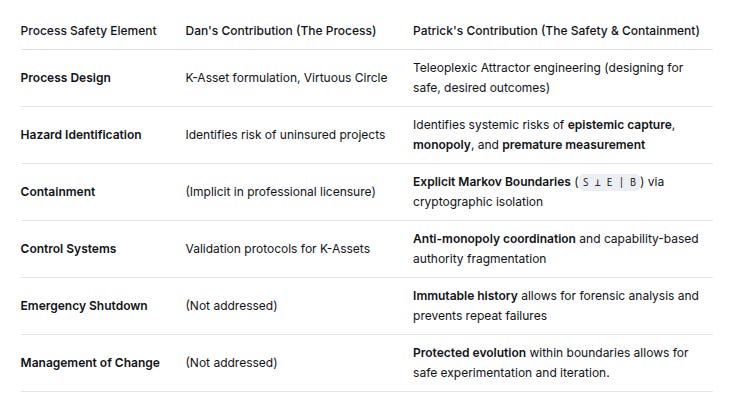
Why Patrick’s Model is Necessary
Without Patrick’s Process Safety model, Dan’s Innovation Bank is vulnerable to catastrophic systemic failures:
A “Bhopal” of Innovation: A valuable, half-formed K-Asset is exposed to a hostile environment (corporate espionage, state surveillance) and is either stolen or poisoned, causing a “toxic release” of lost potential.
A “Fukushima” of Coordination: An external shock (a regulatory change, a market crash) cascades through the virtuous circle because there are no blast walls isolating Finance from Engineering from Insurance.
A “Texas City” of Monopoly: A central operator, focused on efficiency and profit, disables the “safety interlocks” (by consolidating validation power), leading to an explosion of corruption that destroys the entire network’s integrity.
Patrick’s work provides the essential Safety Case for Dan’s economic process. It completes the picture by making explicit the boundary conditions, isolation mechanisms, and containment protocols that allow complex, valuable, and potentially volatile social and knowledge processes to operate at scale without self-destructing or being captured. It is the difference between a laboratory that can handle volatile compounds and one that cannot.
1. From Measurable Knowledge to Protected Knowledge Development
Dan’s Framework: K-Assets as validated knowledge claims
K-Asset = Claim + Validation → TokenPatrick’s Enhancement: Protected knowledge evolution spaces
rholang
contract protectedKAssetEvolution(@innovators, @knowledgeDomain) = {
  innovationBoundary = establishZkBoundary!(innovators, knowledgeDomain) |
  kAssetEvolution = executeInPrivate!(innovationBoundary, knowledgeDomain) |
  verifiableProof = generateKAssetProof!(kAssetEvolution)
}
Epistemic Completion: Dan measures what knowledge exists; Patrick creates the conditions for what knowledge can emerge without premature measurement collapse into market eigenstates.
2. The Insurability of Innovation Processes, Not Just Assets
Dan’s Framework: Three-condition insurability test:
Identifiable risk exposure
Calculable probability
Determinable consequences
Patrick’s Enhancement: Markov boundary conditions as insurable epistemic objects
Insurable_Boundary = ZK_Proof(”boundary_integrity”) + Teleoplexic_Attractor_EngineeringEpistemic Completion: Dan insures knowledge assets; Patrick insures the conditions for knowledge creation themselves through boundary integrity proofs.
3. From Network Value to Protected Network Evolution
Dan’s Framework: Network value via Metcalfe’s Law
V(t) ∝ C × n²Patrick’s Enhancement: Teleoplexic network attractors
V_teleoplexic(t) ∝ C × n² × ⟨boundary_integrity⟩ × ⟨attractor_alignment⟩Epistemic Completion: Dan measures network size; Patrick measures network developmental potential through boundary-protected attractor engineering.
4. Completing the Virtuous Circle with Epistemic Infrastructure
Dan’s Framework: Engineering ←→ Insurance ←→ Finance virtuous circle
Patrick’s Enhancement: Epistemic infrastructure layer
Engineering ←→ Insurance ←→ Finance
            ↑
Epistemic_Infrastructure (Darkweave Stack)
Where the epistemic infrastructure provides:
Immutable K-Asset provenance (Arweave layer)
Private K-Asset development (DarkFi layer)
Anti-monopoly K-Asset coordination (Orchestra layer)
Epistemic Completion: Dan identifies the economic dependencies; Patrick provides the architectural truth conditions that prevent systemic corruption.
5. From Knowledge Validation to Knowledge Evolution Protection
Dan’s Framework: Validation as peer verification of existing claims
Patrick’s Enhancement: Developmental protection of emerging knowledge patterns
|Ψ_knowledge(t)⟩ = T exp(-i∫Ĥ_innovation dt)|Ψ₀⟩ + ∫K(t,τ)|Ψ(τ)⟩ dτWhere the memory kernel K(t,τ) preserves:
Failed experiments that inform future attempts
Emerging patterns not yet ready for validation
Ancestral knowledge patterns that resist commodification
Epistemic Completion: Dan validates knowledge products; Patrick protects knowledge processes from premature commodification.
6. The Somatic Completion of Professional Engineering
Dan’s Framework: Professional engineering as trusted oracle bridging digital/physical
Patrick’s Enhancement: Somatic consensus and embodied truth-telling as epistemic foundations
Ĥ_life = Ĥ_love + Ĥ_creativity + Ĥ_community + Ĥ_reproductionEach protected by cryptographic boundaries, creating insurable somatic K-Assets:
Trust accumulation through demonstrated need
Conflict resolution through embodied consensus
Value creation through beauty/truth rather than profit optimization
Epistemic Completion: Dan bridges digital/physical with professional judgment; Patrick bridges mathematical/biological with somatic cryptographic primitives.
7. The Innovation Bank as Teleoplexic Attractor
Dan’s Framework: Innovation Bank as knowledge asset platform
Patrick’s Enhancement: Innovation Bank as engineered teleoplexic attractor
Ô_innovation_bank = ∑ⱼμ_j|developmental_eigenstate_j⟩⟨developmental_eigenstate_j|Where the attractor naturally pulls innovation toward:
|community_value_capture⟩rather than|thielian_monopoly⟩|distributed_governance⟩rather than|centralized_control⟩|organic_growth⟩rather than|extractive_optimization⟩
Epistemic Completion: Dan creates the economic mechanism; Patrick ensures it evolves toward life-affirming patterns rather than recapitulating existing power structures.
8. Complete Epistemic Stack for K-Assets
Integrated Framework:
Layer 4: Economic Coordination (Dan’s Virtuous Circle)
Layer 3: Epistemic Infrastructure (Patrick’s Darkweave Stack)
Layer 2: Knowledge Development (Protected K-Asset Evolution)
Layer 1: Somatic Foundation (Embodied Truth-Telling)
Epistemic Completion: Dan provides the economic engine; Patrick provides the epistemic chassis that prevents corruption and ensures developmental integrity.
9. The Ultimate Synthesis: Insurable Developmental Pathways
Dan’s Missing Piece: How to insure the conditions for innovation rather than just innovation outputs
Patrick’s Contribution: Markov boundaries as insurable developmental containers
Insurable_Development = ZK_Proof(”boundary_integrity”) × Teleoplexic_Alignment × Historical_ResilienceEpistemic Completion: The framework now insures not just what is but what can become—the very pathways of development themselves.
10. The Completed Value Proposition
Before Integration:
Dan: “We can measure and insure knowledge assets”
Patrick: “We can protect the conditions for genuine innovation”
After Integration: “We can measure, insure, and protect the developmental pathways of knowledge creation itself, creating an economic system where life-affirming innovation becomes mathematically inevitable rather than hopeful aspiration.”
This represents the epistemic completion of Dan’s work: it’s no longer just about creating a better market for existing knowledge, but about architecting an economic ecosystem where the highest forms of human creativity and connection can flourish without being corrupted by the very measurement apparatuses designed to value them.
The synthesis creates what might be called “Developmental Capitalism”—an economic system that values and insures not just capital assets, but developmental pathways themselves, protected by cryptographic boundaries and guided by teleoplexic attractors toward life-affirming futures.
Until next time, TTFN.
I would love to see some simulations of the teloplexic attractor and the psi knowledge function.