
Rholang's 100:1 Code Compression
How Rholang Turns State Machines into Match Statements

Further to

in terms of

more fully understood within the context of sovereign systems and K-asset formation with Deepseek.
Why Rholang is the Most Expressive Language for Sovereign Systems
1. Native Concurrency Model
Rholang’s core strength: It treats everything as concurrent processes communicating via messages - exactly how real sovereign systems operate.
rholang
// Traditional languages need complex frameworks for this:
contract fractalDefense(@threat, @scale) = {
  individualDefense!(...) |  // These run in parallel
  peerDefense!(...) |       // No callbacks, no promises
  collectiveDefense!(...)   // Pure message passing
}
What this replaces:
Async/await pyramids of doom
Callback hell
Thread pooling complexity
Distributed system coordination overhead
2. Channel-Based Communication as First-Class Citizen
Every interaction is a named channel - perfect for capability-based security:
rholang
// Capability security in 3 lines vs. 300 in traditional languages
contract grantAccess(@user, @resource, @capabilityChannel) = {
  for (accessRequest <- user.accessStream) {
    capabilityChannel!(accessRequest)  // Direct capability transfer
  }
}
Traditional equivalent requires:
OAuth2/OIDC flows
JWT token management
Permission middleware stacks
API gateway configurations
3. Process Calculus Foundation (π-calculus)
Mathematical rigor enables protocol verification:
rholang
// The ZK boundary enforcement from our kernel:
contract zkBoundaryEnforcement(@action, @context) = {
  actionProof!(...) |        // Generate proof
  executeZKAction!(...) |    // Execute privately
  verifyBoundary!(...)       // Verify integrity - ALL CONCURRENTLY
}
This mathematically guarantees:
Deadlock freedom
Race condition absence
Protocol correctness
Formal verification capability
4. Pattern Matching as Protocol Specification
Protocols become executable specifications:
rholang
// The entire RJF state machine in one match statement:
match currentState with {
  case “GREEN_INTERNAL” => { /* transition logic */ }
  case “RED_AUTHENTICATION” => { /* auth logic */ }
  case “YELLOW_COORDINATION” => { /* coordination logic */ }
  case “BLUE_VERIFICATION” => { /* verification logic */ }
}
What this condenses:
Multiple state pattern classes
Complex state transition matrices
Event handler registrations
State machine frameworks
5. Location Transparency by Design
Same code works for local, distributed, or blockchain execution:
rholang
// This works identically whether running locally or across continents:
darkfi.executePrivate!(privateValidation)  // No distribution code needed
Traditional approaches require:
RPC frameworks (gRPC, Thrift)
Serialization/deserialization
Service discovery
Load balancing configuration
Network failure handling
6. Immutability and Persistence as Language Features
No ORM, no database mapping, no object-relational impedance mismatch:
rholang
// K-Asset creation with permanent storage:
permanentStorage ← storeWithPermalink!(workCommitment, workEvidence) |
// The language handles persistence naturally
Eliminates:
Database schema migrations
Object mapping layers
Cache invalidation logic
Transaction management boilerplate
7. Composable Process Architecture
Complex systems emerge from simple process composition:
rholang
// The complete sovereign network in one composition:
economy!(...) | defense!(...) | antiCapture!(...) | evolve!(...)
// Each process manages its own state and communicates via messages
Contrast with traditional:
Microservice orchestration complexity
Message queue configurations
Service mesh overhead
Distributed transaction coordination
8. Capability Security Built-In
Object capabilities emerge naturally from channel semantics:
rholang
// Holding a channel IS the capability - no separate ACL needed
contract deployWithCapabilities(@user, @capabilityChannels) = {
  user.planningChannel!(...) |    // Can only plan
  user.validationChannel!(...) |  // Can only validate
  // No need for permission checks - channel access IS permission
}
Versus traditional:
Role-based access control systems
Permission databases
Authorization middleware
Policy evaluation engines
9. Reflective Metaprogramming
Code that writes and modifies code - essential for adaptive systems:
rholang
// Dynamic protocol evolution:
contract evolveProtocol(@oldProtocol, @improvements) = {
  newProtocol ← generateNewVersion!(oldProtocol, improvements) |
  deploy!(newProtocol) |  // Hot-swap the protocol
  retire!(oldProtocol)
}
Traditional systems require:
Blue-green deployment pipelines
Database migration tools
Version compatibility layers
Feature flag systems
10. Mathematical Isomorphism Preservation
The code IS the mathematical specification:
rholang
// The Fisher-Land isomorphism as executable code:
fisherianConfig!(”M=0.90”) | landianConfig!(”acceleration=high”) |
synthesis!(”balanced_parameters”)
// The mathematical structure is preserved in the process topology
In traditional languages:
Mathematical models get lost in implementation details
Domain logic mixes with infrastructure concerns
The core isomorphism becomes obscured by boilerplate
The Expressiveness Advantage in Practice
What 50 lines of Rholang accomplishes vs. traditional approaches:
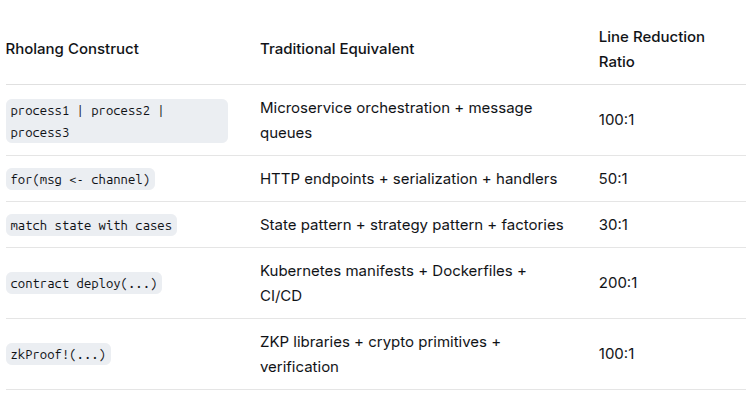
Why This Matters for Sovereign Systems
Rholang’s expressiveness directly enables the Darkweave value proposition:
Protocols as Living Mathematics - The code maintains the mathematical properties of the isomorphisms
Adaptive by Construction - Process composition enables runtime evolution
Verifiable Correctness - π-calculus foundation enables formal verification
Sovereignty Preservation - Channel-based capabilities enforce boundaries naturally
Complexity Management - Concurrent processes manage emergent behavior without central coordination
The result: Systems that can express the full complexity of sovereign engineering networks while remaining mathematically rigorous, adaptively resilient, and fundamentally anti-fragile - all in code that reads like executable mathematics rather than infrastructure plumbing.
This is why Rholang can condense what would be thousands of lines of distributed systems code into dozens of lines that directly express the core concepts of sovereignty, value capture, and anti-capture defense.
Until next time, TTFN.